maandag 22 mei 2017
Trump’s speech in Riyadh signals US escalation against Iran
By
Bill Van Auken
Riddled
with hypocrisy, clichés and absurdities, President Donald Trump’s
speech Sunday before an assembly of monarchs and despots in Saudi
Arabia spelled out an agenda of escalating US militarism throughout
the Middle East and a buildup in particular toward war with Iran.
Hailed
by a fawning American media as “presidential”--supposedly
eclipsing for the moment the crises and factional struggles engulfing
the administration--the speech was reportedly drafted by Stephen
Miller, the extreme right-wing ideologue credited with being the
chief architect of Trump’s abortive executive order banning people
from seven predominantly Muslim nations from entering the US.
Much
in Trump’s half-hour address echoed the speech delivered by Barack
Obama in Cairo eight years earlier. Both presidents declared their
desire to reset US relations with the Middle East, while absurdly
posturing as leaders of a pacifist nation seeking only good for the
region and offering to head up a united struggle against “violent
extremism.”
In
what was meant as a rhetorical invocation to action against
terrorism, Trump told his audience, “Drive them out. Drive them out
of your places of worship. Drive them out of your communities. Drive
them out of your holy land. And drive them out of this earth.”
Like
Obama before him, Trump had no interest in dealing with who brought
Al Qaeda and similar forces in, as the historical trail leads
directly to the CIA in Afghanistan and US imperialism’s
longstanding support for right-wing Islamist organizations and
terrorist groups as a counterweight to left nationalist and socialist
influence in the Arab and Islamic world. Jointly, the US and Saudi
Arabia continue to fund and arm such forces in their drive for
regime-change in Syria.
Both
speeches were laced with flowery tributes to Islamic culture. Trump
noted in particular how impressed he was with the “splendor” of
Saudi Arabia and the “grandeur” of the palace in which the
so-called Arab Islamic American Summit had been convened.
What
separated the two addresses were the different shifts in strategy by
Washington. While Obama sought to repair the damage done by the Bush
administration’s criminal war in Iraq by offering a new face for US
imperialism, Trump traveled to Saudi Arabia to make clear his
administration’s break with his predecessor’s policy of seeking a
rapprochement with Iran based on the 2015 nuclear deal. He adopted an
openly confrontational stance toward Tehran.
“Above
all, America seeks peace--not war,” Trump proclaimed, in what stood
out as the most blatant of the many lies in his brief address. The
reality is that US wars in the region have killed millions over the
past decade-and-a-half. And the thrust of the US president’s visit
to Saudi Arabia, his first stop in a nine-day foreign tour, is the
preparation for new and even bloodier conflicts.
This
was made plain by the principal agreements forged between Trump and
the Saudi monarchy, which included a $110 billion arms deal that
incorporates the option to purchase $350 billion worth of weapons
over the next 10 years.
The
arms agreement “supports the long-term security of Saudi Arabia and
the entire Gulf region,” Secretary of State Rex Tillerson, the
former ExxonMobil CEO, told reporters in Riyadh, “in particular in
the face of the malign Iranian influence and Iranian-related threats
which exist on Saudi Arabia’s borders on all sides.”
In
his speech, Trump painted Iran as the principal state sponsor of
terrorism, accusing Tehran of providing terrorists with “safe
harbor, financial backing, and the social standing needed for
recruitment,” and fueling “the fires of sectarian conflict and
terror,” all charges that could be leveled, with justification,
against his Saudi hosts.
He
portrayed the US cruise missile attack on Syria last month--followed
just last week by the US bombing of a pro-government militia in the
southeastern part of the country--as part of a wider struggle against
Iranian influence. He went on to call upon “all nations of
conscience” to “isolate Iran, deny it funding for terrorism and
pray for the day when the Iranian people have the just and righteous
government they deserve.” That he was speaking in Saudi Arabia, a
brutally repressive absolute monarchy, just two days after more than
70 percent of Iranian voters participated in a sharply contested
election, did nothing to blunt Trump’s call for regime-change.
He
specifically praised Saudi Arabia and its allies for having “taken
strong action against Houthi militants in Yemen.” The
near-genocidal Saudi war has killed some 12,000 Yemenis, while
destroying basic infrastructure in the Arab world’s poorest
country, leaving over 7 million people on the brink of starvation and
unleashing a cholera epidemic that threatens a massive death toll.
In
March, US Defense Secretary James “Mad Dog” Mattis issued a memo
calling for stepped-up US support for this criminal war, in which the
Pentagon is already supplying intelligence and logistical backing to
the Saudi bombing campaign.
Part
of the weapons deal signed by Trump involves the shipment of
precision-guided munitions that had been cut off in a highly limited
gesture of disapproval of Saudi tactics in Yemen by the Obama
administration, which itself concluded over $100 billion worth of
weapons deals with Riyadh. Also included in the new deal are tanks,
artillery, helicopters and other weaponry that can be directly
funneled into the slaughter in Yemen.
In
addition to his speech and the signing of arms and investment deals,
Trump participated in a meeting of the Gulf Cooperation Council, the
Saudi-led coalition of Gulf oil sheikdoms. Trump administration
officials have raised the objective of using the GCC as the
foundation of a Sunni Arab version of NATO directed at military
confrontation with Iran.
Beyond
the drive to militarily confront Iran, a principal regional rival of
US imperialism in the Middle East, and the huge profits that Saudi
arms purchases reap for the US military industrial complex, there are
broader strategic considerations in the US turn toward a closer
alliance with Riyadh.
Some
of these issues were outlined on the eve of Trump’s trip in a piece
published by the influential Washington think tank the Center for
Strategic and International Studies and authored by Anthony
Cordesman, a longtime Pentagon adviser. First among them is,
according to Cordesman, “the continued level of US dependence on
Saudi help in securing the stable flow of Gulf oil.”
While
US imports from the Gulf have fallen sharply over the past
quarter-century, Cordesman cites “indirect dependence” in terms
of the impact a disruption in oil exports would have on global energy
prices and the world capitalist economy. In particular, he points to
the dependence of Asian economies on Gulf petroleum exports.
If
the United States failed in “providing power projection forces and
arms” to the region, he writes, its principal global rival, China,
might fill the void. “China may not yet be ready to try to assume
the role, but the entire South China Sea crisis would pale to near
insignificance if China became the de facto guarantor of Gulf
stability.”
Cordesman
continues: “The real-world nature of US influence and power in the
Pacific would be cut massively, China’s leverage over other major
Asian economies like Japan and South Korea would be sharply
increased, and the potential rise in tension between China and
India--and cut in India’s relative position--would have a massive
impact on the balance of power in South Asia and the Indian Ocean.”
In
other words, the turn toward closer relations with Saudi Arabia and
the related Gulf oil sheikdoms is bound up with US imperialism’s
mounting conflict with China, which it has identified as the
principal challenge to the drive for American global hegemony.
Washington is determined to dominate Asia, including China, by
maintaining the military power to choke off the region’s energy
imports.
The
fact that the sclerotic House of Saud, one of the world’s last
absolute monarchies, has become a lynchpin of Washington’s
imperialist strategy, not only in the Middle East but globally, is a
measure of the crisis of American and world capitalism.
Oil
revenues, which account for fully 90 percent of the kingdom’s
export earnings, have been cut nearly in half since 2014. Last month,
the government was forced to reverse itself on austerity measures
that hit the military and public employees over fear that declining
living standards and rising unemployment are creating the conditions
for social revolt.
In
the predominantly Shia Eastern Province, the center of the kingdom’s
oil production, security forces laid siege to the town of Awamiyah, a
center of resistance to the regime, during the week preceding Trump’s
visit. Combined with the failure of the Saudi bid to topple the Assad
regime in Syria by supporting Al Qaeda-linked militias and the
regime’s inability to retake Yemen from the Houthi rebels, the
deepening domestic crisis is creating the conditions for
revolutionary upheavals against Washington’s principal ally in the
Arab world.
This
article first appeared on World
Socialist Web Site (WSWS)
on 22
May 2017,
and was republished with permission.
Labels:
Afghanistan,
Article in English,
China,
India,
Irak,
Iran,
Japan,
Jemen,
Koreaans schiereiland,
Saudi Arabië,
Syrië,
VS
vrijdag 28 april 2017
Wordt Noord-Korea Trump’s gevaarlijkste blunder?
Donald
Trump kan
nog
bitter
weinig
op zijn palmares schrijven. Hij
komt niet over als een rationeel leider, en toont een
opvallend gebrek aan dossierkennis.
Trump’s
presidentschap lijkt
te
mislukken.
Dat
geldt voor zijn binnenlands én
buitenlands
beleid.
De crisis met Noord-Korea wordt
zijn achilleshiel.
Donald Trump kan nog bitter weinig op zijn palmares schrijven. Hij komt niet over als een rationeel leider, en toont een opvallend gebrek aan dossierkennis. Trump’s presidentschap lijkt te mislukken. Dat geldt voor zijn binnenlands én buitenlands beleid. De crisis met Noord-Korea wordt zijn achilleshiel.
Trump
ontpopt zich als een klassieke Republikein. In
plaats van zijn beloftes aan de “vergeten Amerikanen” in
uitvoering te brengen kondigt
hij een belastinghervorming aan die de
rijken bevoordeelt.
Hij
verleent steun aan een nieuw
gezondheidszorgstelsel
dat
24 miljoen Amerikanen buiten de boot laat vallen. Hij maakt
geen werk
van de beloofde biljoenen investeringen in infrastructuur, maar
blijft wel hameren op zijn “prachtige”
muur langs de grens met Mexico. Zijn
verschillende pogingen om Moslims de toegang tot Amerika te ontzeggen
faalden. En
zijn verbale druk op Amerikaanse ondernemingen om komaf
te maken met het exporteren van jobs is meer schijn dan echt
gemeend.
In
zijn buitenlands beleid breekt Trump
met
zijn belofte om komaf te maken met de
confrontatie met
“ongehoorzame” landen, en
met
de
eindeloze Amerikaanse oorlogen. Hij
gaf zich gewonnen in de harde en aanhoudende Rusland-hetze van de
media en heeft
zich zonder
verpinken neergelegd
bij het
gedachtengoed van de neoconservatieven. Dat
uit zich in de
hondse houding ten opzichte van Israël
en Saoedi-Arabië. Die
landen schilderen Iran
af
als de
belangrijkste aanstichter van terrorisme, en
Trump en zijn team nemen die valse boodschap over. Binnen de
regering-Trump gaan er zelfs stemmen op om het nucleaire akkoord met
Iran op te zeggen, niet omdat Iran kernwapens ontwikkelt,
maar vanwege de nieuwe
macht van Iran in het Midden-Oosten na de mislukte Amerikaanse
oorlogen.
Trump
en zijn team leggen
ijskoud
de
schuld van alle ellende in het Midden-Oosten bij Iran, en laten
Israël,
Saoedi-Arabië en Amerika zelf vrijuitgaan.
Geen woord over de aanstichters
van deze ellende: president
George W. Bush en de neoconservatieve kliek die - met Israelische
steun - besloten
tot de
rampzalige invasie van Irak, president
Barack Obama en buitenlandminister Hillary Clinton die hamerden op
regime
change
in Libië en Syrië, en
Saoedi-Arabië en de Golfstaten die instonden voor de bewapening en
financiering van Al Qaida, IS en andere Soennitische
terreurgroepen. En
tenslotte Israël, dat al tientallen jaren de inheemse Palestijnse
bevolking terroriseert, buurland Libanon binnenvalt en de Syrische
Golanhoogte wederrechtelijk bezet houdt.
Iran
draagt juist
bij
aan het bestrijden van IS en Al Qaida in Irak en Syrië. Maar
deze terreurgroepen zijn de instrumenten
van Saoedi-Arabië en de Golfstaten om hun
doelstellingen in het Midden-Oosten te realiseren. Dus is Iran de
zondebok. En ook Rusland, dat Syrië militair steunt.
Onder zware druk van beide politieke partijen, het Pentagon en de
inlichtingendiensten heeft
Trump zijn plan ingetrokken om de relaties met Rusland te verbeteren.
Hij
voerde de
druk juist op. Zo stationeerde hij NAVO-troepen in de Baltische
landen, onmiddellijk langs de grens met atoommacht Rusland, en komen
NAVO-gevechtsvliegtuigen bij herhaling dicht bij een treffen met
Russische straaljagers. En
hij vuurde
59
Tomahawk-raketten af
op Syrië om door
het politieke establishment voor
vol te worden aangezien.
Die
aanval maakte hij bekend tijdens het staatsbezoek van de Chinese
president Xi
Jinping, met
als boodschap dat hij even “doortastend” kon
optreden in
Noord-Korea. De
manier waarop hij hierover de
media informeert zegt
veel over zijn karakter: “Ik zei de president: we hebben juist 59
raketten afgevuurd, die wonderbaarlijk, van op honderden kilometer,
allemaal doel hebben getroffen. En Xi keek op zijn neus.” Maar
over wat er werkelijk gebeurde hoort men Trump niet. Een
aantal raketten zwaaiden
af en
maakten
in een nabijgelegen dorp tien burgerslachtoffers. Hoewel Trump
bezwoer dat Xi akkoord was met de aanval ligt het meer voor de hand
dat Xi in het maniakale gedrag van Trump een bevestiging zag van de
gevaarlijke
leeghoofdigheid die veel van zijn critici in hem zien.
De
manier waarop Trump communiceert
over Noord-Korea bevestigt niet enkel zijn leeghoofdigheid, maar ook
roekeloosheid. “Noord-Korea moet zijn kernwapens en raketten
opgeven. Er is absoluut kans op een heel groot conflict. Ik zie
liever een
diplomatieke oplossing, maar dat zal heel moeilijk worden. Xi
Jinping doet
zijn uiterste best om Noord-Korea in het gareel te krijgen want die
wil geen dood en verderf zien.” Intussen
heeft het Witte Huis
de vroegere president Jimmy Carter met klem gevraagd
niet met de Noord Koreanen te gaan praten. “Dat kan het Amerikaanse
beleid enkel bemoeilijken. Carter heeft er
eerder
al eens
voor gezorgd dat een Amerikaanse regering van koers moest veranderen.
Dat was in 1994 toen Bill Clinton een militaire aanval op Noord-Korea
overwoog.”
Bereidt Trump de publieke opinie voor op een militaire
confrontatie met Noord-Korea, of
wil hij echt onderhandelen?
Buitenlandminister Rex
Tillerson zegt
dat er kan worden onderhandeld, mits voorafgaandelijk akkoord over de
agenda. Een
kernwapenvrij Koreaans schiereiland moet het doel zijn. Tillerson mag
dan begrip tonen voor de behoefte van de Noord-Koreanen om
afdoende afschrikking te hebben voor akties gericht op regime
change
en hereniging met Zuid-Korea, de Amerikaanse geloofwaardigheid is
gering. Een
ieder kent het Amerikaanse optreden in Afghanistan, Irak, Syrië en
Libië, landen die geen nucleaire afschrikking hadden, of hun
kernwapenprogramma onder
Amerikaanse druk hadden opgegeven.
Amerika
zal uit een ander vaatje moeten tappen. Als het Noord-Korea in het
gareel wil krijgen zal de VS moeten stoppen met de aanhoudende
provocaties. Tientallen Amerikaanse, Zuid-Koreaanse
en Japanse oorlogsschepen
voeren
omvangrijke oefeningen uit in de onmiddellijke omgeving van het
Koreaanse schiereiland. Video’s tonen grootschalige
landmachtoefeningen met scherpe munitie vlak bij de
gedemilitariseerde zone. Wie gelooft nog in de defensieve aard van
die oefeningen, nu die passen in een agressief operationeel plan,
OPLAN
5015, dat voorziet in preëmptieve aanvallen op Noord-Korea en
acties om de leiders om te brengen?
Trump
houdt
niet
van lezen. Hij
kijkt liever naar de actualiteitenprogramma’s.
Buitenlandse Zaken is
nog
niet op sterkte.
Het
probleem is dat de
regering-Trump zich
niet verdiept in de voorgeschiedenis.
Maar
dat geldt ook voor vorige Amerikaanse regeringen. Ambassadeurs zijn
geen geschoolde diplomaten, maar mensen die iets in bedrijfsleven of
organisatiewereld hebben gepresteerd, en vooral de zittende president
in zijn campagne (financieel) hebben gesteund. Het
verhaal dat men alles heeft geprobeerd en wel met geweld moet
optreden klopt
gewoon niet. In
1994 bracht Bill Clinton een Kaderakkoord met Noord-Korea tot stand:
Noord-Korea zou zijn kernwapenplannen opgeven, de
VS zou vijandige acties verminderen. Dat werkte min of meer, tot het
aantreden in 2001 van George W. Bush. Die maakte
Noord-Korea
tot
deel van
de “As van het Kwaad” en stelde sancties in. Dus
hervatte
Noord-Korea zijn kernwapenprogramma.
In
2005 kwam er dan een heel
verstandig, nieuw,
voorstel
op tafel.
Noord-Korea was bereid zijn kernwapenprogramma te stoppen. In ruil
vroeg men een niet-aanvalsverdrag: geen Amerikaanse
oorlogsretoriek,
geen sancties, en een
akkoord over de
productie van laag-verrijkt uranium voor medische en andere
doeleinden. Bush verwees dat voorstel onmiddellijk naar de vuilbak en
stelde harde sancties in. Die
waren
erop gericht om
Noord-Koreaanse financiële transacties met de buitenwereld
onmogelijk te maken. De reactie laat zich raden: Noord-Korea pakte
zijn kernwapenprogramma weer op.
Dat
Noord-Korea kernwapens nodig heeft als afschrikking is voor een ieder
duidelijk. En
ook vandaag ligt er een voorstel op tafel: Noord-Korea stopt zijn
kernwapenprogramma, in ruil voor stopzetting van dreigende
Amerikaanse
militaire
oefeningen tezamen
met
Zuid-Korea direct aan de Noord-Koreaanse grens. Dat lijkt toch geen
onredelijk voorstel. Toch werd het gewoon van tafel geveegd. En ook
Obama deed dat. Eenvoudige stappen kunnen de kans op een zeer
ernstige crisis verkleinen. Gebruikt
de VS geweld tegen Noord-Korea, dan wordt volgens militaire bronnen
de stad Seoel per direct van de kaart geveegd door de omvangrijke
Noord-Koreaanse artillerie. En wat staat er dan nog te gebeuren?
Vergelijk zo’n scenario met het voorstel voor een diplomatieke
oplossing. Blijkbaar vreest wereldmacht Amerika voor gezichtsverlies.
En
laat ons niet vergeten dat Noord-Korea een olifantengeheugen heeft.
Het land werd praktisch vernietigd in de intensiefste bombardementen
van de geschiedenis. Men
moet er eens de officiële Amerikaanse
Luchtmachtannalen op naslaan. Noord-Korea
was compleet platgebombardeerd. Geen enkel doelwit stond nog
overeind. Dus moesten ook nog de dijken worden aangevallen. Een pure
oorlogsmisdaad. En de Amerikanen waren daar nog trots op ook: “het
water vernietigt de oogst, dat zal ze afmaken.” Dat hebben de
Noord-Koreanen allemaal mogen meemaken. Begrijpen we nu dat
Amerikaanse
B-52
bommenwerpers aan hun grenzen die met kernwapens kunnen worden
uitgerust voor hen geen lachertje zijn?
De
geschiedenis leert dat diplomatiek overleg tot
stappen
in de goede richting hebben
geleid,
sancties en hard optreden contraproductief waren en er vandaag opties
op tafel liggen die kunnen worden opgevolgd. Is
Trump verstandig genoeg om die weg te bewandelen? Het heeft er alle
schijn van dat ook hij niet leert uit het verleden. Het
wapengekletter in de Koreaanse wateren en bij de gedemilitariseerde
zone is te hevig geweest. Buigt Noord-Korea niet en gaat het
onverstoord door met zijn kernwapen- en
rakettenprogramma,
dan ligt oorlog in het verschiet. China zal Noord-Korea niet
eenvoudig tot de orde kunnen roepen, China voelt zich immers evenzeer
bedreigd door het
THAAD
raketafweersysteem,
waartegen mensen in Zuid-Korea ook steeds meer protesteren.
De
crisis rond Noord-Korea
herinnert
aan
de Cubacrisis
van 1962, toen
de wereld vlak voor een kernoorlog stond. Die crisis kon worden
opgelost door geheim overleg tussen rationeel denkende leiders in
Amerika en de Sovjet-Unie. Vandaag kennen we in China en Rusland even
rationeel denkende leiders, maar dat kan van wereldmacht Amerika niet
worden gezegd. Het
wordt spannend.
Labels:
China,
Cuba,
Irak,
Iran,
Islamic State,
Israel,
Japan,
Koreaans schiereiland,
Libië,
Qatar,
Saudi Arabië,
Syrië,
VS
zaterdag 25 februari 2017
Pentagon prepares for bigger, bloodier war in Iraq and Syria
Syrian
opposition asks
US-led coalition to halt attacks on Isil after dozens of civilian
deaths. “(Syria)
condemns, with the strongest terms,
the two bloody massacres
perpetrated by the French and US warplanes and those affiliated to
the so-called international
coalition
which send their missiles and bombs to the civilians
instead of directing them to the terrorist gangs,”
it said in a letter sent to the
United Nations this week, according
to state news agency SANA.
By
Bill Van Auken
The
Pentagon has prepared recommendations to be submitted to President
Donald Trump at the beginning of next week for a major escalation of
the US military intervention in Iraq and Syria.
According to unnamed US officials cited Friday by the Wall Street Journal, the proposal is expected to include “sending additional troops to Iraq and Syria” and “loosening battlefield restrictions” to “ease rules designed to minimize civilian casualties.”
The
new battle plans stem from an executive order signed by Trump on
January 28 giving the Pentagon 30 days to a deliver a “preliminary
draft of the Plan to defeat ISIS [Islamic State] in Iraq and Syria.”
According
to independent estimates, as many as 8,000 civilians have already
died in air strikes carried out by US and allied warplanes against
targets in both Syria and Iraq, even as the Pentagon routinely denies
the vast majority of reported deaths of unarmed men, women and
children resulting from US bombings. The new policy to be rolled out
next week, which the Journal reports
is aimed at “increasing the number and rate of operations,” will
inevitably entail a horrific intensification of this bloodletting.
Speaking
before the Center for 21st Century Security and Intelligence at the
Brookings Institution in Washington on Thursday, the chairman of
Joint Chiefs of Staff, Marine General Joseph Dunford, said that the
Pentagon would be presenting Trump with a “political-military plan”
to deal not only with ISIS in Iraq and Syria, but to “advance our
long-term interests in the region.”
Referring to the intense contradictions besetting the US intervention in the region, which has relied on the use of Kurdish militias as proxy ground troops in Syria, even as Washington’s NATO ally, Turkey, has intervened to militarily counter their influence, Dunford insisted that Washington “can’t be paralyzed by tough choices.”
Pointing
to the regional scope of the planned US military escalation, Dunford
echoed earlier bellicose rhetoric from the administration against
Iran, listing it alongside Russia, China, North Korea and
“transnational violent extremism” as the major targets of the US
military.
The
US military commander stated that “the major export of Iran is
actually malign influence across the region.” He said that the US
military buildup against Iran was designed to “make sure we have
freedom of navigation through the Straits of Hormuz, and that we
deter conflict and crisis in the region, and that we advance our
interest to include our interest in dealing with violent extremism of
all forms.” All of these alleged aims are pretexts for continuous
US provocations aimed at countering Iran’s regional influence and
furthering the drive for US hegemony in the Middle East.
In
relation to Iraq, Dunford signaled US intentions to maintain a US
military occupation long after the campaign against ISIS is
completed. He referred to a “dialog about a long-term commitment to
grow the capacity, maintain the capacity of the Iraqi security
forces,” adding that Iraq’s Prime Minister Haider Abadi had
spoken of “the international community continuing to support
defense capacity building.”
Dunford’s
comments echoed those of Secretary of Defense James “Mad Dog”
Mattis during a trip earlier this week to Baghdad. While disavowing
Trump’s crude comments last month—“We’re not in Iraq to seize
anybody’s oil,” Mattis said—he also suggested that plans are
being developed for a permanent US military presence in the country.
“The
Iraqi people, the Iraqi military and the Iraqi political leadership
recognizes what they’re up against and the value of the coalition
and the partnership in particular with the United States,” Mattis
told reporters Monday. “I imagine we’ll be in this fight for a
while and we’ll stand by each other.”
Currently,
Washington has more than 5,000 US troops in Iraq and another 500
Special Forces troops operating inside Syria. These forces are backed
by tens of thousands of military contractors as well as other
military units that are rotated in and out of the region. The plan to
be presented next week will likely involve the deployment of
thousands more US combat forces.
Trump
has repeatedly indicated his support for establishing “safe zones”
in Syria, an intervention that would require large numbers of US
soldiers backed by air power to seize and control swathes of Syrian
territory. It would also entail threats of military confrontation
with Russian warplanes operating in support of the Syrian government.
As
the Pentagon prepares its plans for military escalation in the
region, US ground forces have reportedly entered Mosul, operating on
the front lines with Iraqi forces in the bloody offensive to retake
Iraq’s second-largest city from ISIS. American Special Forces
“advisers” joined Iraqi troops Thursday in the first incursion
into western Mosul, with the retaking of the Mosul International
Airport as well as a nearby military base. The operation was
conducted with close air support from US warplanes.
The
airport and the base, located in the southern part of western Mosul,
are to be used as the launching pad for a major assault into the most
densely populated area of the city, where an estimated three quarters
of a million civilians are trapped with no means of escape.
The
International Rescue Committee warned that this stage of the
offensive would represent the “most dangerous phase” for
civilians.
“This
will be a terrifying moment for the 750,000 people still in the west
of the city, and there is a real danger that the battle will be
raging around them for weeks and possibly months to come,” said
Jason Kajer, the Iraq acting country director for the humanitarian
group.
Referring
to the increasingly desperate plight of civilians in western Mosul,
the International Committee of the Red Cross’s field coordinator in
Erbil, Dany Merhy, said: “Supply routes have been cut from that
side of the city and people have been facing shortages of food,
water, fuel and medicine. We can only imagine the state people will
be in.”
As
in previous US-backed offensives against Fallujah and Ramadi, Mosul
faces the prospect of being reduced to rubble. It is in this city
where the proposed changes in the “rules of engagement” will find
their first expression in the elevated slaughter of Iraqi civilians.
This
article first appeared on World
Socialist Web Site (WSWS)
on
25
February 2017,
and was republished with permission.
Labels:
China,
Irak,
Iran,
Islamic State,
Koreaans schiereiland,
NAVO,
Rusland,
Syrië,
VS
dinsdag 17 januari 2017
Het mislukte presidentschap van Barack Obama
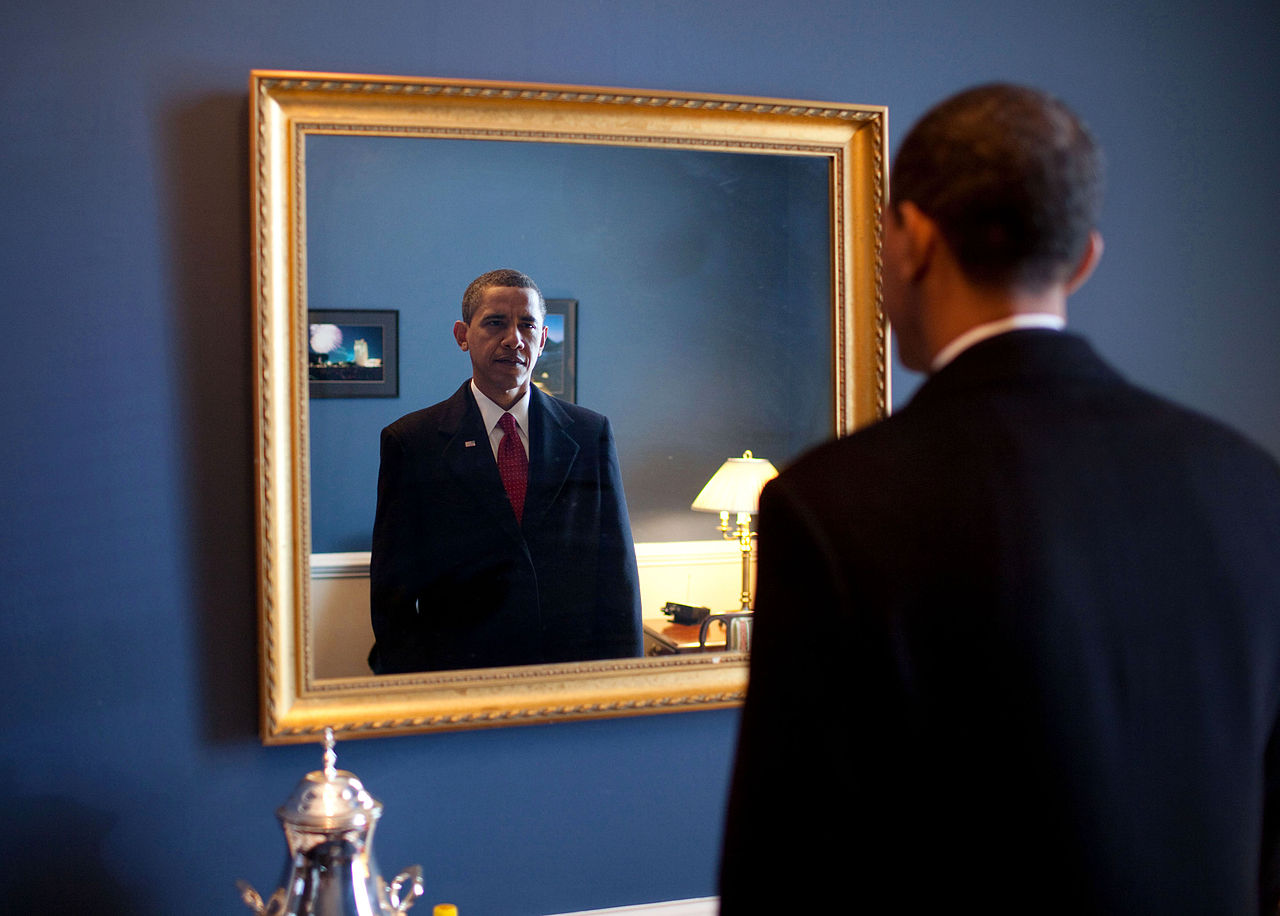
Barack
Obama takes one last look in the mirror, backstage before going out
to take oath of office, Jan. 20, 2009.
(Official
White House photo by Pete Souza)
Howard
Zinn zag in 2010, een jaar na Obama’s
aantreden, geen enkel hoogtepunt en
voorzag een middelmatig en daarmee gevaarlijk presidentschap. Het
oordeel van Eric Zuesse aan
het eind van de rit is niet mis: Obama
is een mislukte president.
Bij zijn aantreden in 2009 werd Barack Obama wel heel uitbundig verwelkomd. Zijn campagne draaide om hoop. Gerechtigheid, onkreukbaarheid, gelijkheid, vrede, geluk en voorspoed, zaken waarop je kon rekenen met zo’n intelligente, goed opgeleide, achtenswaardige man. Zijn eerste wapenfeiten maakten indruk: Obamacare, de afrekening met Osama bin Laden, opkuis van de federale bureaucratie. Maar na de recente stormachtige politieke ontwikkelingen in de VS moeten we de realiteit onder ogen zien. Hoop en verandering zijn geweken voor frustratie en zorg. Obamacare staat op losse schroeven, en de talloze executive orders en ondertekende wetgeving lijken gedoemd om te worden herroepen.
De
befaamde Amerikaanse
historicus
Howard
Zinn had
op 17
november 2008
al
zijn bedenkingen bij de toen
nog president-elect.
Die
moest
voor Zinn direct
na zijn aantreden zijn
dan
nog maximale politieke
kapitaal investeren in fundamenteel nieuw beleid: troepen
terug uit Irak en Afghanistan, geen aanvalsoorlogen meer, afstand van
de Bush-doctrine
en
de
Carter-doctrine,
en
komaf met
de
overzeese
militaire basissen. Uitroeping
van Amerika als vredelievende
mogendheid
die
niet langer doelwit is
van
terrorisme en zelf ook geen
terrorisme
uitoefent.
Inkrimping
van het
militaire apparaat en het defensiebudget tot
het minimum en
jobcreatie
voor
jonge mensen in plaats van hen voor het leger te recruteren.
Ruim
een jaar later evalueerde
Zinn het eerste jaar van de regering-Obama: “Ik zie geen enkel
hoogtepunt in zijn optreden en beleid. Ik denk dat de mensen verblind
zijn door zijn retoriek. Obama wordt een middelmatige president, en
in onze tijd betekent dat een gevaarlijke president.” Die evaluatie
dateert van een week voor zijn overlijden, zodat Zinn vandaag geen
eindoordeel kan geven over het presidentschap van Barack Obama. Dat
deed
de eveneens Amerikaanse historicus Eric Zuesse recent wel. En diens
oordeel is niet mis: Obama is een mislukte president.
Op
het vlak van jobcreatie:
94% van alle nieuwe jobs zijn gedwongen
parttime. De armoede steeg in 94% van de kiesdistricten.
Honderdduizenden doden
en miljoenen ontheemden door bombardementen in opdracht van Obama of
diens bondgenoten. De verwoesting van Irak en Afghanistan door George
W. Bush kreeg
een vervolg met de vernietiging van Libië door Obama en Sarkozy,
en
van Syrië door Obama,
Saud, Thani en
Erdogan.
Tienduizenden
jihadisten
werden bewapend en naar Syrië gestuurd om de regering-Assad omver te
werpen. Volop
steun aan de
barbaarse junta in Honduras waar
het
moordcijfer
met 50% steeg en daarmee tot het hoogste ter wereld.
Per
saldo heeft de regering Obama veel meer ellende aangericht buiten de
VS dan in eigen land, aldus
Zuesse.
Dat
heeft Hillary Clinton niet veel stemmen gekost, Amerikaanse kiezers
weten weinig over wat er zich in het buitenland afspeelt. Trump legde
in zijn campagne wel de nadruk op de ‘illegale immigranten’, maar
zweeg over het feit dat die mensen de hel die de VS in hun land had
aangericht wel moesten ontvluchten, niet enkel in Honduras, maar ook
in
Guatemala en
El
Salvador. Coups
en
door de VS getrainde doodseskaders,
dat
was steevast de aanpak. Om
maar niet te spreken over
de vluchtelingenstroom uit het Midden-Oosten waar Europa mee moet
afrekenen.
Obama
is niet mislukt omdat hij te
weinig
conservatief of ‘Christelijk’ was, maar omdat hij te weinig
progressief was en in veel opzichten veel conservatiever dan zijn
dubbelhartige verkiezingsretoriek beloofde.
Een uitzonderlijk getalenteerd leugenaar, die daarmee ook fenomenaal
succes had. Obama werd
dan gedwarsboomd door het Congres,
maar zijn falen komt
toch op
zijn
conto.
Kwalijke
zaken als de mislukte TTP, TTIP en TISA handelsverdragen, de moord op
Gaddafi en de coup in 2014 in Oekraïne stonden
prominent
op zijn agenda. Een
conservatieve, reactionaire agenda, die meer rekening hield met de
belangen van de honderden CEO’s van multinationals dan van de
Amerikaanse
bevolking die de president geacht wordt te dienen.
De
regering-Obama scoorde een absoluut dieptepunt op het vlak van
vervolging van witte-boorden-criminaliteit. Frauderende
bankiers werden niet vervolgd. Landen
als Oekraïne en Rusland worden afgeschilderd als corrupt, maar de
corruptie in eigen land wordt onder de mat geveegd. De Amerikanen
hebben het vandaag dan beter dan aan het eind van de regering-Bush,
maar
niet dan voor de crisis van 2007/2008.
De
economische opleving onder Obama was de zwakste sinds de 2e
Wereldoorlog. De schuld van de Amerikaanse federale overheid
verdubbelde. Hoewel
na een economische crisis de economische ongelijkheid normaal afneemt
bleef
die
onder
Obama onveranderd hoog.
Tot
daar het
harde
oordeel
van Zuesse.
Maar
ook anderen
zien Obama als de grote verliezer, zeker op het wereldtoneel. De
impasse in Oekraïne, de
steun aan jihadistisch
terrorisme met
de afslachting
van meer dan een half miljoen mensen in Syrië en Irak tot
gevolg,
de
electorale steun aan Hillary Clinton
die
mede aan de basis lag van het succes van de als clown afgeschilderde
Donald
Trump, het
verlies aan geloofwaardigheid door de mislukte poging om het hacken
van Amerikaanse servers in de schoenen van Rusland te schuiven, de
kwaadaardige poging om Iran met
blijvende sancties te
verzwakken ondanks het bereikte diplomatieke akkoord, de
steun aan
Saoedi-Arabië in
de bloedige
oorlog
tegen
het
Jemenitische
volk, het
gebrek aan ruggengraat in het Israel-Palestina conflict, de
infrastructurele, sociale, politieke en rassencrisis in
het binnenland.
En
nu doet dus Donald Trump zijn intrede in het Witte Huis. Diens
overwinning wordt door de Amerikaanse mainstream
media
toegeschreven aan Russische
hackers die zich in opdracht van Poetin zouden hebben gemengd in de
Amerikaanse democratie, een beschuldiging die Rusland als
“belachelijk” van
de hand heeft gewezen, net als Trump. Zo ver is het dus gekomen
onder Obama. Men
weigert de
realiteit van het politieke en sociale binnenlandse verval onder ogen
te zien en
wijst
met het beschuldigende vingertje naar een buitenlandse mogendheid.
Maar
die boodschap komt niet over. Het
sentiment onder de burgers wijst op afkeer van de politieke elite in
Washington en de media die worden gezien als onderdeel van een
corrupt systeem.
Het
is dezelfde afkeer die we ook elders in het Westen tegenkomen. Mensen
zijn de elitaire overheden beu die falend soberheidsbeleid voeren,
een nieuwe Koude Oorlog tegen Rusland ontketenen, de NAVO op basis
van valse Russofobie opblazen tot ongekende proporties en slaafs het
Amerikaanse imperialisme volgen.
De
wereld die Obama achterlaat kenmerkt zich door Westers beleid,
internationale instellingen en klassieke media in verval. Hoe meer de
schuld bij “tegenstanders” als Rusland, China, Iran en
Noord-Korea wordt gelegd, hoe meer de mensen in opstand komen tegen
hun leiders. En dat is geen goed vooruitzicht.
Labels:
Afghanistan,
China,
Europa,
Handelsverdragen,
Irak,
Iran,
Israel-Palestina conflict,
Jemen,
Latijns-Amerika,
Libië,
NAVO,
Oekraïne,
Qatar,
Rusland,
Saudi Arabië,
Syrië,
VS
Abonneren op:
Posts (Atom)